
The Vanuatu Sales Monitoring System (VSMS) is officially launched, ushering in a new stage of digital tax transformation for the Pacific island nation. Last week the Department of Customs and Inland Revenue (DCIR), in close collaboration with Data Tech International, activated the production environment and successfully onboarded the first large taxpayers, who issued the inaugural production fiscal receipts using the system’s free web-based invoicing tool.
In Vanuatu, a nation of 300,000 souls scattered across 83 islands, it feels like the arrival of something big. The system, built by Data Tech International and powered by its TaxCore® engine, is the Pacific’s third fiscal-monitoring platform after Fiji’s VMS and Samoa’s TIMS. That makes Vanuatu the latest small-island state to bet that technology, not just goodwill, is the best weapon against the informal economy and the revenue leakage that has long plagued low-capacity tax administrations.
The launch centred on a targeted event at the Port Villa’s Warwick Le Lagon Hotel, where DCIR brought together Vanuatu’s largest taxpayers, the businesses that form the pillar of national revenue. Finance Minister Hon. Johnny Koanapo Rasou delivered the opening address, framing the reform in clear, practical terms while underscoring its mandatory nature.
5 Takeaways
- VSMS is now live and already processing real transactions: The system entered production with the first large taxpayers successfully onboarded. They issued the inaugural production fiscal receipts using the free web-based invoicing tool provided by Data Tech International, marking the official start of real-time digital sales monitoring in Vanuatu.
- Strong high-level political commitment and clear legal obligation: Finance Minister Hon. Johnny Koanapo Rasou called VSMS a “major step forward in the modernisation and digitalisation of our tax administration.” He explicitly stated that the Government of Vanuatu views it not only as a modernisation initiative, but also as a legal obligation established under the applicable legislation of the Republic of Vanuatu.
- Phased, business-friendly rollout with support measures in place: The implementation adopts a phased approach (starting with large/very large taxpayers, followed by medium, then small and micro businesses) to minimise disruption. Businesses can choose the no-cost government web portal or any certified commercial fiscal solution.
- Long-term benefits emphasised by both government and DTI: DCIR Director Harold Tarosa called VSMS “an important step toward strengthening transparency and improving tax compliance across the country” that will “help create a fairer business environment.” Data Tech International CEO Goran Todorov reinforced this view, stating that digital fiscal tools deliver efficient day-to-day operations,” often reducing long-term administrative effort and costs.
- Vanuatu joins a Pacific club of real-time fiscal monitoring adopters: Powered by TaxCore®, VSMS makes Vanuatu the third Pacific island nation after Fiji (VMS) and Samoa (TIMS), to implement such a system. Over more than one year of structured collaboration, combined with on-site support during the launch and the successful onboarding of the first taxpayers, the project team has delivered a confident and methodical start to what they position as a cornerstone of Vanuatu’s broader digital transformation.
Vanuatu Sales Monitoring System: Commitment to Transparency and Efficiency
The minister positioned VSMS as both a modernisation effort and a legal requirement. “The Government of Vanuatu, through the Department of Customs and Inland Revenue, is committed to strengthening the integrity, transparency, and efficiency of our tax system,” he said. “One of the key steps in this direction is the implementation of the Vanuatu Sales Monitoring System.”
“VSMS represents a major step forward in the modernisation and digitalisation of our tax administration,” he emphasised. “It is designed to improve transparency in business transactions, promote fair competition across the market, and strengthen our ability to combat tax evasion and the informal economy.”
At the same time, he highlighted the system’s intent to ease compliance. “At the same time, the system is intended to simplify and streamline compliance for businesses. Through the introduction of standardised fiscal solutions and digital processes, VSMS will help create a more predictable and transparent environment for both taxpayers and the tax administration.”
Legal Obligation and Compliance Deadlines
The minister was explicit about the obligations ahead. “I would like to emphasise that the introduction of VSMS is not only a modernisation initiative, it is also a legal obligation established under the applicable legislation of the Republic of Vanuatu.” He added: “The system is now fully operational and available for use. Businesses are expected to take the necessary steps to comply with the new requirements, including the use of accredited fiscal solutions and the issuance of fiscal invoices through the system.”
Large and very large businesses must meet the final compliance deadline of 1 July 2026. By then, they must accredit their systems and actively issue invoices through the VSMS platform.
Recognising the practical challenges, the minister acknowledged costs while pointing to mitigating measures. “We recognize that the introduction of fiscal solutions will require certain investments on the side of businesses. For that reason, the Government of Vanuatu has taken steps to support taxpayers during this transition.”
He framed the event’s purpose plainly: “The purpose of this session is to help you better understand the system, the compliance requirements, and the steps necessary to ensure a smooth transition.”
Vanuatu Sales Monitoring System: Live Demonstrations and First Onboardings
The event itself delivered on that promise of support. DCIR staff demonstrated the system live, guiding participants through onboarding. Each day, at least one taxpayer completed enrolment on stage and issued their first compliant fiscal receipt via the free web tool, transactions that marked the official start of production data capture.
The rollout follows a phased model to minimise disruption. Very large enterprises with annual turnover of 100 million Vatu or more have a compliance deadline of 30 June 2026. Medium enterprises with annual turnover of 10 million Vatu or more but less than 100 million Vatu have a compliance deadline of 30 September 2026. Small and Micro Businesses with annual turnover of 4 million Vatu or more but less than 10 million Vatu have a compliance deadline of 31 December 2026.
What Businesses Have to Do
Before the applicable deadline, every business must register for enrolment in VSMS through the official link, install and maintain an accredited fiscal solution (or use the free web-based invoicing tool), and complete full enrolment in the VSMS system.
All businesses are strongly encouraged to begin the process early to ensure timely and smooth compliance. For guidance, accreditation details, or additional support, contact the Department of Customs and Inland Revenue (DCIR). Compliance options remain flexible: the no-cost web portal or any vendor solution that passes certification in the VSMS sandbox environment, keeping the ecosystem competitive.
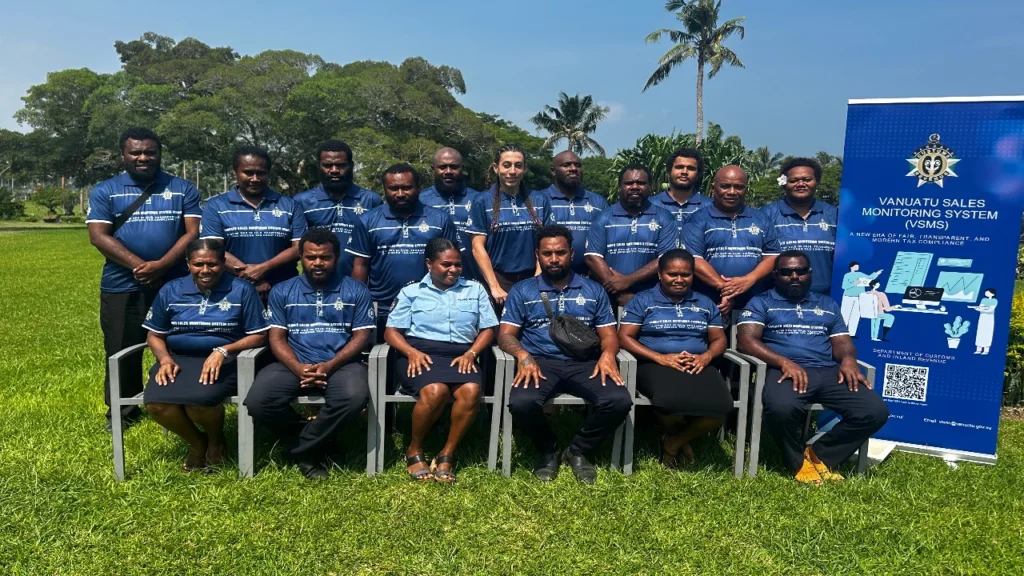
Implementation unfolded over more than a year of structured collaboration, beginning in March last year shortly after contract signing. Key milestones included legislative adoption in August, joint governance structures, system development, infrastructure setup and sandbox accreditation for vendors. During the launch, Data Tech International’s account manager Maja Miodragovic worked on-site with DCIR’s project manager George Brechtefeld, director Harold Tarosa, deputy director Collins Gesa and the dedicated VSMS team to ensure smooth operations and rapid issue resolution.
Our View on the VSMS Journey
Goran Todorov, CEO of Data Tech International, expressed deep satisfaction with the collaboration and optimism about its long-term impact. “It has been a sincere pleasure for us to work alongside the Department of Customs and Inland Revenue on the VSMS project,” he said. “We see this as much more than a mere compliance reform. It, definitely, is an important step in Vanuatu’s broader digital transformation, and I believe the future it opens is very promising for both government and the business community.”
Addressing the practical concerns that many business owners are likely to have, Todorov offered reassurance grounded in the company’s experience implementing similar systems in other jurisdictions.
How Will This Affect My Business?
“We understand that many taxpayers’ first concern is simple: ‘How will this affect my business, my daily work, and my costs?’ That concern is natural. Any new system brings adjustment,” he acknowledged. “But our experience across multiple countries shows that this change is ultimately positive. Once businesses begin using digital fiscal tools, they gain verifiable records of every transaction, better control over sales, easier accounting, stronger credibility, and more efficient day-to-day operations. In many cases, it also reduces administrative effort and the long-term cost of doing business.”
He concluded on a forward-looking note, framing the reform as an opportunity rather than a burden. “Digitalisation may begin as a legal obligation, but very quickly it becomes a practical business advantage. That is why we are confident that, over time, taxpayers in Vanuatu will not only adapt to VSMS, but will also recognize its value for running their businesses in a simpler, more transparent, and more professional way.”
Goran Todorov’s comments strengthen the same message from the Minister of Finance and DCIR leadership: even though the transition requires effort, every party involved will gain a modern, transparent, and mutually beneficial tax environment that makes the investment worthwhile.
Reflections from DCIR Leadership
Director Tarosa, reflecting on the achievement, described VSMS as “an important step toward strengthening transparency and improving tax compliance across the country,” adding that it will “help create a fairer business environment while modernizing the way tax administration operates in Vanuatu.”
With Vanuatu now the third Pacific nation, after Fiji and Samoa, to deploy a TaxCore®-powered fiscal monitoring solution, the successful go-live and first onboardings signal a confident start. The coming months will see broader enrolment, continued taxpayer support and steady expansion of the system across the business community.
For an economy where transparent revenue collection directly supports resilience and public services, the launch of VSMS represents progress that is as pragmatic as it is purposeful.