
One might say that the Pacific Islands are not often associated with tax innovation. But at a recent meeting of the Pacific Islands Tax Administrators Association (PITAA), held in the Tongan capital, a small set of island nations made a surprisingly assertive case: real-time tax monitoring is not only attainable, but is already positively influencing their economies.
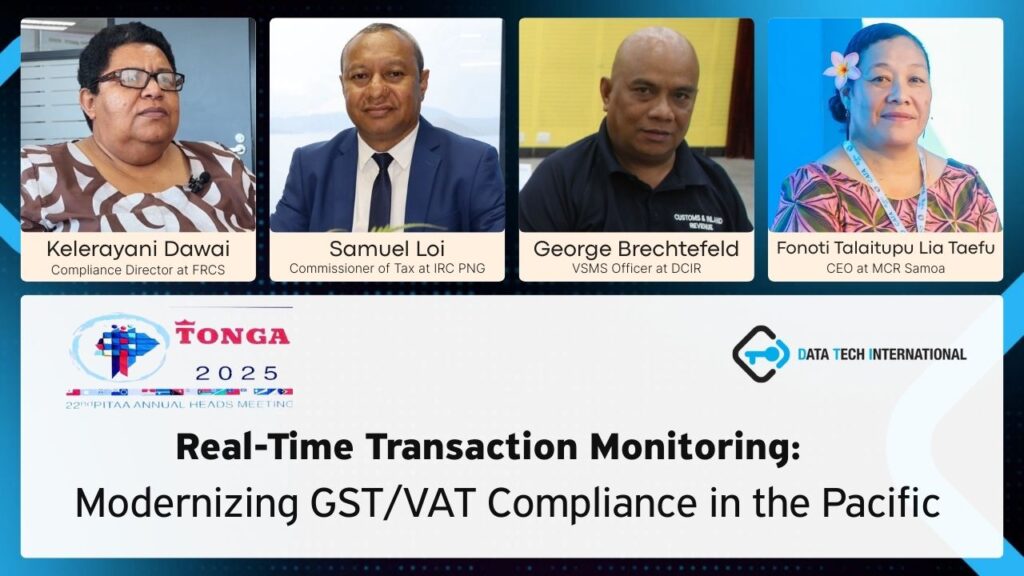
From the PITTA meeting stage, Goran Todorov, chief executive of Data Tech International, framed the stakes of the panel, called “Real-Time Transaction Monitoring: Modernizing GST/VAT Compliance in the Pacific”, bluntly. “Real-time transaction monitoring changes the way revenue administrations work. It gives you information at the moment it happens.”
He added the warning that became the session’s refrain: “If you wait for monthly or quarterly filings… you are already too late.”
Around him sat senior officials from Fiji, Samoa, Papua New Guinea and Vanuatu, each addressing different political, technical and economic constraints, yet arriving at a shared conclusion: real-time data may be the region’s most effective weapon against revenue leakage.
5 Key Takeaways
1. Real-time tax monitoring is operational: Pacific nations demonstrated that real-time transaction data is already reshaping how governments track sales, enforce compliance, and protect revenue. As Moderator Goran Todorov put it: “If you wait for monthly or quarterly filings… you are already too late.”
2. Fiji’s results show the power of transparency at scale: With over 677 million invoices, as of today, and 46.6 billion FJD in recorded sales now visible on a public dashboard, Fiji has shifted from speculation to data-driven oversight. Compliance Director Kelerayani Dawai says the change was immediate: “The data started coming to us.”
3. Samoa proved that political turbulence doesn’t have to derail reform: Despite early pushback and a change of government, Samoa’s TIMS system survived because real-time data brought fairness and credibility to the tax process. As CEO Fonoti Talaitupu Lia Taefu said: “Electronic invoicing gave us visibility we never had.”
4. Vanuatu exposed hidden revenue and changed business attitudes: A pre-launch manual survey revealed 2 billion Vatu in previously unrecorded sales. Once TaxCore® implementation started, businesses adapted quickly. The country is now enrolling taxpayers and accrediting vendors into the system, a process Brechtefeld said is proceeding faster than expected
5. PNG sees real-time data as the key to trust in the tax system: With widespread mistrust and inconsistent assessments, PNG is betting on nationwide GST monitoring to restore confidence. Commissioner Samuel Loi argues: “We need accurate information at the point of sale. That’s where the tax is lost.”
Fiji: Proof in the Data
Fiji was the first mover, adopting digital fiscalization through VAT Monitoring System (VSMS) powered by DTI’s Taxcore® in 2017. Compliance Director Kelerayani Dawai explained why the country pushed ahead: consumption taxes are central to the national budget. “VAT or GST is 40% of Fiji’s revenue,” she said. “So that is why we have taken this step to be the first in the region.”
Before the system, Fiji relied on returns that often did not match reality. The new data stream changed the dynamic immediately. “Once the system went live, we saw businesses starting to issue receipts correctly. We didn’t have to chase them. The data started coming to us.”
The numbers she cited emphasized the Public Dashboard that was recently released and that shift: more than 656 million invoices, 46.6 billion Fijian dollars in recorded sales, and over 530,000 receipt scans by consumers verifying authenticity for every Fijian to see.
What this yielded was rare in tax administration: spontaneous compliance. “We are no longer guessing,” she said. “We can see what is happening.”
Samoa: Real-Time Tax Monitoring Through Turbulence
On another hand, Samoa’s implementation was more turbulent. Its real-time system, known as TIMS once again powered by DTI’s signature software, drew early resistance from small enterprises and became entangled in a political transition in 2021.
“When the new government came in, one of the changes they wanted to see was the removal of TIMS,” recalled Fonoti Talaitupu Lia Taefu, chief executive of the Ministry of Customs and Revenue.
To keep the system alive, officials returned to consultations and parliamentary committees. “You cannot continue with something that doesn’t have political support,” she said.
Ultimately, the government accepted the system. What convinced lawmakers, Fonoti said, was the way real-time data leveled the playing field and stabilized revenue. “Electronic invoicing gave us visibility we never had,” she said. “It reflects what is actually happening in our economy.”
It was not a story of uninterrupted progress, she added, but one of persistence. “Our staff understand the data, our taxpayers understand their obligations, and the system helps both sides.”
Vanuatu: Measuring the Invisible
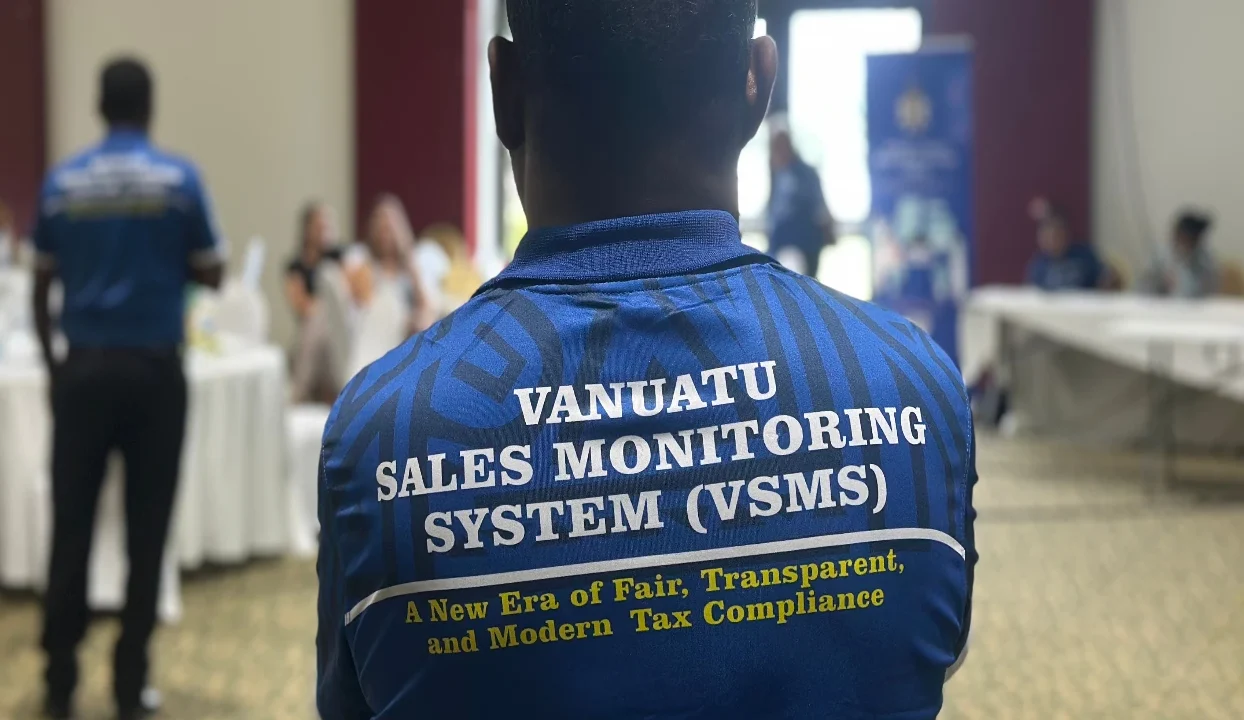
In Vanuatu, the one of the newest adopters, the Inland Revenue Department plans to use real-time monitoring to expose what many suspected but could not prove: the country’s sales tax base is far larger than the records suggested.
Ahead of the Vanuatu Sales Monitoring System (VSMS) implementation which is another instance of TaxCore®, officials hired students to manually count transactions in retail shops to compare against reported sales.
George Brechtefeld, who leads the VSMS program, described the findings: “The sales in December 2023 showed that we collected an extra 2 billion Vatu.” For a small economy, the discovery was staggering. It also shifted attitudes among businesses.
“Our plan is that by November and December, we should start a roll out of the taxpayers, especially those who already have a POS system and they should get their system accredited into the VSMS, then once that is done they can transmit data into TaxCore.” Brechtefeld confirmed.
Local revenue authority has been encouraging taxpayers to pay for their own solution, specifically the external sales data controller. Then once they can transfer the data to TaxCore, intention of the Government is to refund the money to the taxpayer for the initial investment into devices.
Papua New Guinea: Trust and Scale
Papua New Guinea, the region’s largest and most complex economy, has recently signed a contract with DTI for the nationwide rollout of the Goods and Services Tax Monitoring System (GMS) powered by our TaxCore®. This way, PNG is stepping straight into the digital times. And, for Samuel Loi, Commissioner of Tax, the urgency is driven as much by public mistrust as by administrative challenges.
“The answer is yes… mistrust between taxpayers and the government is still strong,” he said. He attributed this partly to inconsistent or delayed assessments: “Taxpayers in PNG often feel uncertain about the assessments and whether they are fair or not.”
Real-time data, he said, can close that gap, especially for GST, which PNG aims to make its top revenue source. “We need accurate information at the point of sale. That’s where the tax is lost, and that’s where we must have control.”
With more than 85 percent of the population engaged primarily as consumers rather than formal employees, Loi argued that transparency at the transaction level is essential for equity.
Real-Time Tax Monitoring: A Regional Message
If the Pacific once followed global tax trends from afar, the officials here argued the opposite is now true. Todorov returned repeatedly to the question of fairness: “The moment of creation of the invoice… a seller and a buyer are aware of the transaction, as well as the government. All three parties have the same perception of the data, and you will agree that is only fair.”
The leaders on stage echoed the point in their own ways. “We have seen the difference,” Dawai said. “This supports the structure we need for the future,” Fonoti added. “When you have real information, you can protect your revenue,” Loi said. And Brechtefeld captured the sentiment most simply: “It works.”
The Broader Appeal of Pacific’s Model
Around the world, revenue authorities are searching for reliable ways to close revenue gaps without imposing new taxes or burdensome audits. What the Pacific demonstrated in a single morning was a model based on real-time facts that practically show that domestic revenue mobilization is possible within the current financial settings.
Finally, in a region often perceived as peripheral to global policy debates, the message was unambiguous: transparency is possible, affordable and operational, not theoretical. And the implications go well beyond the islands now leading the way.