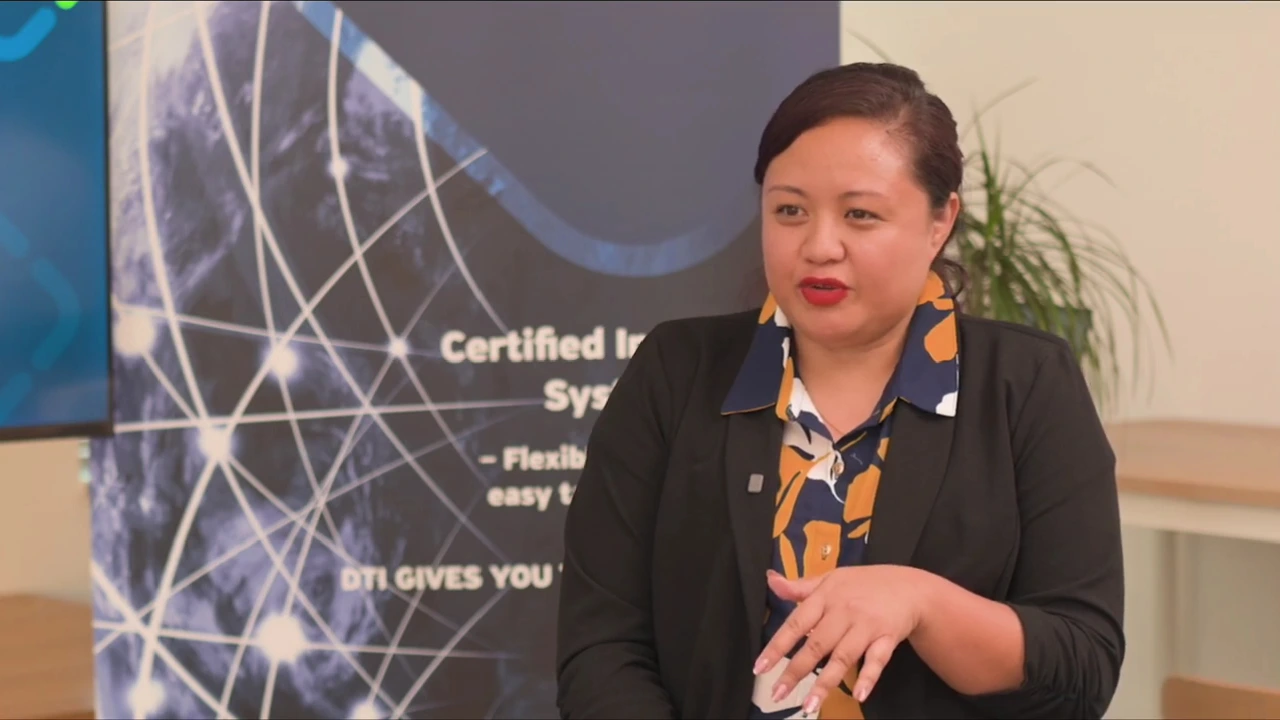

Far from the rolling hills of Eswatini, DTI’s CEO Goran Todorov welcomed in the company’s Belgrade HQ a visitor whose strong determination is reshaping how an African nation collects the taxes that fund its future. Mr. Brightwell Nkambule, Commissioner General of the Eswatini Revenue Service, had travelled to Data Tech International’s offices in Serbia and Republic of Srpska as a partner in a transformation already under way. What began as a strategic decision to strengthen domestic revenue mobilization is becoming something rarer: a system designed so that honest businesses barely notice they are complying.
Todorov leaned forward, his tone warm. “Hello Mr. Brightwell, welcome to Serbia and welcome to Data Tech International.” Mr. Nkambule returned the greeting with measured courtesy. “Thank you and good morning, Goran. Thank you for welcoming me here at DTI in Serbia.”
The conversation that followed was not about technology for its own sake. It was about the stubborn realities that had long limited Eswatini’s revenue potential and the path now opening beyond them.
5 Key Conclusions From Brightwell Nkambule Interview
- TaxCore Turns Compliance into the Path of Least Resistance. The system was chosen not only to detect underreporting and the informal economy, but to make compliance easier and cheaper than non-compliance, especially for smaller businesses previously burdened by high costs of accountants and complex returns.
- Digital Foundations Were Already Delivering Results. Before TaxCore, earlier digital tools had already lifted voluntary compliance from 60% to 72%, raised the Net Promoter Score to 75%, and improved the tax-to-GDP ratio from 15.7% to 16.5%, proving technology works when it genuinely reduces friction.
- Real-Time Reporting Solves the High-Volume Retail Problem. Previous VAT reporting methods collapsed under the weight of thousands of daily transactions. TaxCore automatically captures and transmits every business-to-consumer sale as it happens, eliminating the need for manual schedules or daily summaries.
- It Closes Fraud Loopholes and Empowers Citizens. The biggest leakage occurred in cash-heavy business-to-consumer sales and “cooked” invoices linked to under-declaration at the border. TaxCore captures every transaction at source and allows consumers to verify that the VAT they paid truly reaches the revenue service.
- The Ultimate Goal Is Compliance by Default. Commissioner General Nkambule’s vision mirrors Pay-As-You-Earn: taxpayers should focus entirely on growing their businesses while technology silently handles tax obligations. Higher compliance strengthens government finances, improves public services, reduces poverty, and creates jobs, making the real winners the citizens of Eswatini.
The Weight of What Went Unseen
Before TaxCore, the challenges were familiar and persistent. Underreporting of sales was widespread. Entire segments of the informal economy simply did not report at all. For smaller businesses, the cost of compliance, accountants, consultants, complex returns, often outweighed the perceived benefit of staying inside the system.
“We had a whole range of issues,” Brightwell Nkambule explained. “One of them was underreporting of sales, and then the other was no reporting at all, this is what we sometimes call the informal economy. We decided we must opt for solutions that will reduce the risk of underreporting and also make it very easy for taxpayers that may be in the informal economy to comply.”
The solution had to do more than catch non-compliance. It had to lower the barrier so that compliance became the path of least resistance.
Progress Already Measured
Eswatini’s Commissioner General did not arrive empty-handed. Under his leadership, and building on years of earlier work, the Eswatini Revenue Service had already introduced a range of digital tools aimed at making voluntary compliance easier. The results were tangible.
Voluntary compliance, measured by on-time filing and payment, had risen from around 60 percent in 2022 to 72 percent in the latest financial year. The Net Promoter Score, tracking how willing taxpayers were to recommend the service, had climbed to 75 percent. The tax-to-GDP ratio had improved from roughly 15.7 percent to 16.5 percent.
“Technological solutions actually have an impact,” Nkambule noted. The foundations were in place. What was still missing was a system capable of capturing the full flow of transactions, especially in the high-volume retail sector that had proven hardest to police.

Brightwell Nkambule: The Game Changer Arrives
TaxCore is still early in its implementation, still the ERS head already sees it as transformative. He traced the evolution of VAT reporting in Eswatini. Introduced in 2012 with a simple one-line return, the system soon revealed serious underreporting. In 2022 the authority introduced invoice schedules, which improved performance, until the sheer volume of daily transactions overwhelmed retailers. A compromise was reached: daily sales totals instead of line-by-line detail. The figures began slipping again.
“TaxCore will come in and say that the problem of voluminous transactions has been solved,” Nkambule said, “because this solution will automatically report the transactions to us as and when they occur. So, it’s going to be a game changer.”
The wholesale and retail sector currently sits below expected thresholds. The VAT-to-turnover ratio, which should sit between 1 and 3 percent, has in places fallen below zero, a sector effectively operating on net refunds because outputs are not fully declared. Real-time transmission changes the equation. Every business-to-business and business-to-consumer transaction becomes visible. The technology does the reporting. The taxpayer simply runs the business.
For smaller and informal operators, the barrier drops even further. A one-time investment in a simple device or free software on an existing phone or computer is enough. After that, the system records, stores, and transmits. “There’s nothing to submit anymore,” he observed. “The technology will be doing all the work.”
Closing the Gaps That Fraud Exploits
The most stubborn leak has been business-to-consumer sales. Retailers could under-declare or omit cash transactions because the revenue authority had no independent view. Some went further, linking under-declaration at the border with under-declaration at the point of sale, “cooking” the invoices to match.
TaxCore severs that chain. Every transaction is captured at source. Consumers themselves can verify that the VAT they paid has reached the tax office. Nkambule is confident many will. “A big portion of our citizens are responsible. They want to contribute to the development of the country… We see them stepping forward to ensure that this VAT that they pay ends up with the tax office.”
A Message of Ease, Not Fear
Asked what message he would send home to taxpayers in Eswatini after seeing the system working in Serbia and Republika Srpska, Commissioner General was clear. The solution benefits the country. The VAT citizens already pay will finally reach the revenue service. The cost of compliance will fall sharply after a modest upfront step. The system, once running, is low maintenance, “much like our mobile phones. Once you have a mobile phone, all you need to take care of is the battery.”
For the smallest businesses, free applications that run on existing phones or computers remove even that modest barrier. Compliance becomes accessible rather than burdensome.
Brightwell Nkambule Sees the Larger Picture
In Eswatini, the next chapter is already being written, not in threats or heavier audits, but in a silent promise: that honest businesses will one day spend almost no time thinking about tax at all. What excites him most is not the technology itself, but what it unlocks. Higher compliance strengthens government finances. Stronger finances improve public services. Better services accelerate national development, reduce poverty, and create jobs.
He draws a parallel with Pay-As-You-Earn. Employees do not file monthly; the system handles compliance by default. TaxCore points toward the same destination for VAT and broader reporting: taxpayers concentrate on growing their businesses while the technology quietly does the rest.
“The country develops, poverty is reduced, jobs are increased, everyone is happy after that,” Nkambule concluded. The technology will simply make compliance the default. And when that happens, the real beneficiaries will not be the revenue service alone, but the citizens whose development depends on every tax that finally arrives where it belongs.