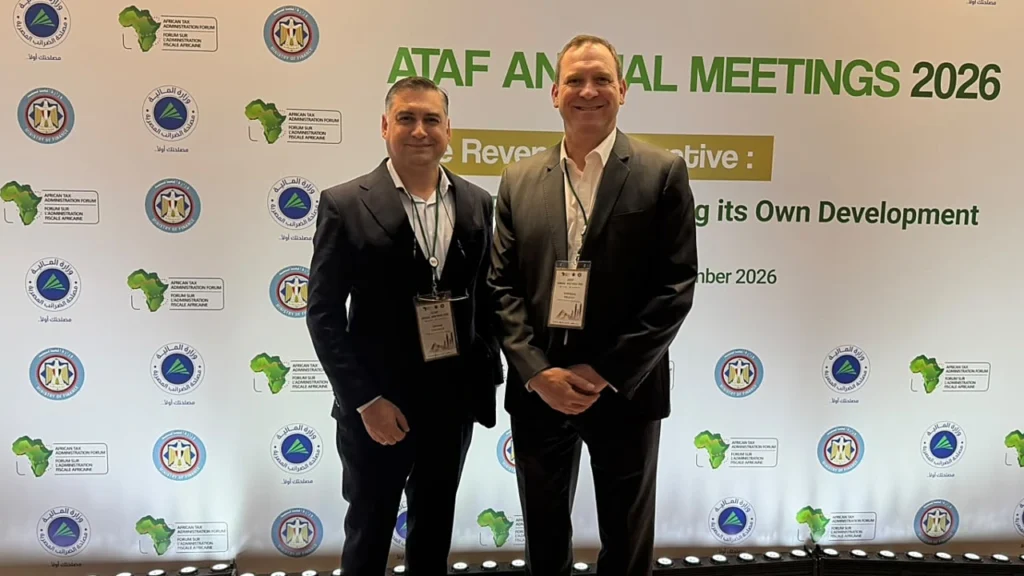
At a conference devoted to Africa’s financial sovereignty, I found myself thinking about a telephone call traveling through multiple jurisdictions, two customs officers examining different prices for the same shipment, and a software engineer who had left his job. An unlikely collection of characters, perhaps. Yet each has something to tell us about a government’s ability to collect the taxes it is legally owed. These were among the thoughts I carried away from ATAF 2026, the African Tax Administration Forum’s Annual Meetings, held in Cairo under the theme “The Revenue Imperative: Africa’s Path to Financing Its Own Development.” It was a fitting choice of words for a continent whose economic ambitions are considerable and whose fiscal room for manoeuvre remains painfully constrained.
The discussions were refreshingly candid. Africa needs stronger domestic revenue mobilization, dependable institutions and greater influence over the international rules governing taxation. There was little disagreement about the destination. The more interesting questions concerned the journey, particularly who should build the necessary machinery, how countries can cooperate and what happens when the machinery fails.
Having spent much of my professional life working with revenue authorities on fiscalization, I tend to view such questions through the less glamorous realities of implementation. Tax policy can be drafted in a minister’s office. Its success is eventually determined in tax offices, shops, customs terminals and databases, where legislation encounters the stubborn particulars of daily commerce.
Five Key Takeaways from ATAF 2026
1. Institutional sovereignty must be earned through competence. A revenue authority needs the expertise to govern its systems, interpret its data and remain operational when people, policies and technology change.
2. The build-or-buy debate deserves a longer memory. In-house software, commercial solutions and technology shared between administrations should be judged by their performance over years, including their ability to accommodate legislative changes.
3. International taxation increasingly depends on understanding individual transactions. Digital payments and cross-border services require authorities to establish who supplied what, to whom, and where consumption occurred.
4. Reliable digital invoices can strengthen the fight against illicit financial flows. Verifiable transaction records can make discrepancies easier to investigate, provided they are supported by customs evidence and professional judgement.
5. Cooperation needs practical experiments. Modest, measurable projects between willing administrations may accomplish more than elaborate programs whose results remain difficult to demonstrate.
When the Software Supplier Leaves, the Tax Authority Stays
One of the most absorbing discussions at ATAF 2026 in Cairo concerned institutional modernisation. The question at the heart of Session 9 was familiar to anyone who has worked with government technology: should a revenue authority develop its own systems or purchase them from an external supplier?
I understand the attraction of building in-house. Public institutions have occasionally paid dearly for software that arrived late, performed poorly or became an expensive hostage to its supplier. Those experiences leave scars, and understandably so. A revenue authority cannot simply close its doors because a contractor has failed to honour a maintenance agreement.
Nonetheless, I would resist treating every commercial supplier as guilty by association. Reputable providers of commercial off-the-shelf software deserve to be judged on their record, just as internal development teams should be. The most revealing test comes several years after implementation, when legislation changes and the system must change with it.
I would ask a vendor’s existing customers a simple question: When your tax rules changed, did your supplier deliver the necessary update on time, and did it work? I would put the same question to an administration relying on its own developers. What happens when the people who built the system retire, resign or accept a better offer elsewhere? Institutional memory is a precious asset. It is also surprisingly good at walking out of the building.
A Third Way, Courtesy of Zambia and Lesotho
ATAF 2026 also reminded me that revenue authorities need not always choose between building something themselves and buying it from a commercial vendor. Africa has accumulated considerable administrative experience, and some of that knowledge can travel across borders.
ATAF’s November newsletter highlighted an interesting example. Following a visit to the Zambia Revenue Authority, Lesotho chose to adopt Zambia’s Tax Online system. The prospect of one African administration learning from another, and potentially reusing its technology, deserves serious consideration.
Naturally, transferring software between institutions is no trivial undertaking. Tax laws differ, operational requirements vary and local capacity determines whether an apparently attractive solution can be maintained. The economics of the arrangement must also withstand scrutiny.
What matters most is the institution’s ability to govern the technology it uses. A capable revenue authority should be able to define its requirements, test the software against legislation, supervise its operation and manage future changes. Ownership of the source code is one consideration. Competence, continuity and accountability are what ultimately protect the public interest.

What a Telephone Call Can Teach Us About VAT
A different discussion took us into the rather peculiar geography of international taxation. Session 5 examined Africa’s role in negotiating the UN Framework Convention on International Tax Cooperation, a process with important implications for the continent’s fiscal future.
Egypt’s Deputy Minister of Finance for Tax Policy and Reforms, H.E. Ramy Youssef, captured the ambition in a memorable sentence: “If we change them together, we can build a system every treasury can trust.” I found myself considering what such trust would require when the underlying economic activity crosses several jurisdictions.
Imagine someone in London calling Los Angeles. The signal may pass through Canada, although neither caller has any particular interest in Canadian geography. Should the Canadian leg of the journey create a VAT obligation there? The answer depends on the nature of the underlying supplies, the parties involved and the applicable tax rules.
In my view, a Canadian carrier providing transit services to a foreign telecommunications operator should generally be treated as exporting a service eligible for zero-rating under the relevant rules. The carrier’s remuneration is a separate transaction from the amount paid by the original caller. Distinguishing those transactions is essential. The internet has made the world remarkably efficient at moving information; determining its tax treatment remains a rather more demanding occupation.
Money Moves Quickly. Understanding It Takes Longer.
The problem becomes more interesting when we follow the payment. A customer purchases a digital service through a platform. One payment is made, yet the proceeds may be divided almost instantly among several participants, each performing a different commercial function.
The customer receives an electronic invoice showing the total price. That document may tell the tax administration relatively little about how the money was subsequently allocated. A telecommunications carrier, platform operator and intermediary may each receive a share. Their respective supplies can have different tax consequences.
This is why I place considerable importance on transaction-level information. At Data Tech International, TaxCore captures fiscal transactions and makes records available to authorised parties, using digital signatures and blockchain-based mechanisms to support their integrity. These capabilities provide a foundation for understanding what was recorded and verifying that the information has remained intact.
The next opportunity lies in cooperation between jurisdictions. Connecting relevant transaction records, with proper legal safeguards and agreed access rights, could help administrations establish the relationships between payments, suppliers and taxable supplies. International agreements will determine the rules. Reliable data will help officials apply them.
ATAF 2026: The $90 Billion Question Behind Africa’s Borders
Few figures discussed at ATAF 2026 in Cairo were more sobering than the estimated US$90 billion Africa loses annually through illicit financial flows, as cited during Session 6. The estimate encompasses activities of considerable complexity. Recovering such sums will demand sustained cooperation, capable investigators and effective legislation.
My attention, however, settled on a particularly practical problem. Suppose an exporter records one value for a shipment while the importer declares another. How quickly can the authorities in the two countries establish what the seller actually invoiced?
In today’s trading environment, the explanation may be entirely innocent. Freight, insurance, valuation adjustments or a subsequent credit note can account for differences. Unfortunately, reconciling those details can consume considerable administrative time, particularly when documents must be obtained separately from several parties.
A digitally signed invoice can improve the starting position. TaxCore records the issuer, time and declared amount of a transaction in a form whose integrity can be verified. That gives investigators a dependable record of what was issued. It does not establish that the declared price reflects the goods shipped. Customs evidence, commercial documentation and professional judgement remain indispensable, as does beneficial ownership information when relationships between buyer and seller require examination.
The Case for an Experiment That Fits on One Trade Corridor
This is where I see a promising application for DTI’s proposed Digital Invoice Customs Exchange (DICE). The idea is upfront: allow authorised authorities to exchange verifiable digital invoice information and match it with customs declarations relating to the same shipment.
Consider what this could mean in practice. An officer investigating a discrepancy would have access to an authenticated record of the original invoice. Supporting documentation could explain the difference, allowing the query to be resolved. Where a material inconsistency remained, the authorities would have a specific transaction on which to concentrate their investigation.
I would welcome a pilot involving two willing administrations, a single trade corridor and one commodity. Measure the proportion of shipments successfully matched, the time needed to reconcile discrepancies and the number of cases requiring further investigation. Record the obstacles as carefully as the successes.
Such an experiment would tell us a great deal about the practical value of cross-border invoice exchange. It would also reveal the legal and operational changes needed before expanding the approach. For an industry sometimes inclined to admire the size of its technological ambitions, a modest project producing credible evidence would be a welcome achievement.